Interval Training for Beginners: How to Alternate Work and Rest
How to plan your first interval workout: choose work and rest periods, set a timer, manage the intensity, and progress gradually.
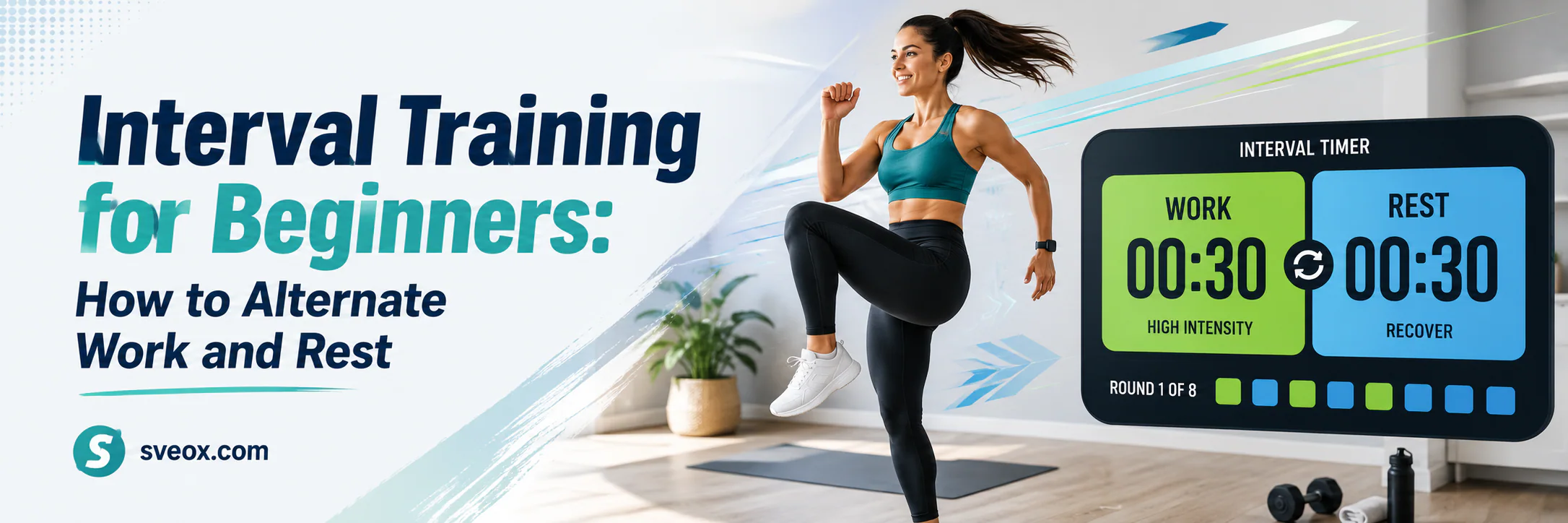
Interval training consists of repeated periods of work and recovery. For example, you might walk briskly for 30 seconds, slow down for a minute, and repeat the pair several times. You can use intervals for running, walking, cycling, swimming, strength exercises, or equipment-free workouts at home.
Beginners do not need to start at top speed. Choose an effort that lets you maintain good form through the final round, with enough rest to prepare for the next one. A convenient interval timer handles the timing, so you do not have to watch the clock or count seconds in your head.
Try free MeoVC QR Code Generator
How interval training works
An interval has two main parts:
- work period: the time when you speed up or perform an exercise at your chosen intensity;
- recovery: a pause or a period of easier movement before the next work period.
One work-and-rest pair makes a round. Several rounds make up the main workout block. You also need a warm-up beforehand and an easy cool-down afterward. A basic session therefore consists of a warm-up, several identical rounds, and a cool-down.
Interval training does not have to be high intensity. Alternating brisk and easy walking follows the same principle. What defines the format is the planned change in effort.
Intervals are particularly useful when it is still difficult to maintain the desired pace without stopping. Instead of running continuously for ten minutes, you can complete several short runs with walking in between. The work periods give you practice, while recovery keeps the movement manageable.
Choosing work and rest periods
Interval length depends on the exercise, pace, and your current fitness. Thirty seconds of climbing stairs feels different from thirty seconds of squats, so no single ratio works for every activity.
For a first workout, it makes sense to keep recovery longer than the work period. A practical starting point is 20–30 seconds of work followed by 40–60 seconds of rest. Adjust these approximate times to the exercise and how you feel. If your breathing does not settle or your form starts to break down, shorten the work period, lengthen the rest, or choose an easier exercise.
Recovery can be passive or active. During passive recovery, you stand, sit, or change position before the next round. During active recovery, you keep moving at an easier pace: switch from running to walking, pedal more slowly, or take relaxed steps in place. Active recovery is often more comfortable for continuous activities such as walking and cycling because you do not have to stop abruptly.
Do not judge the plan by the first two rounds alone. Rest that seems adequate at the start may prove too short as fatigue builds and your pace drops sharply midway through the workout. A suitable beginner plan lets you finish every repetition without racing the timer or noticeably losing form.
Finding the right intensity
Keep something in reserve during each work period instead of pushing as hard as you can. Your breathing should become faster and long sentences should be harder to say, but your movement should remain controlled. During recovery, your breathing gradually settles, and you are ready to repeat the exercise by the next signal.
Three simple signs indicate that the intensity is too high:
- you cannot maintain your chosen pace after only a few repetitions;
- you have to shorten your range of motion or compromise your form to keep up the speed;
- the recovery period is not long enough for you to move confidently again.
There is no need to endure this just to follow the numbers in the plan. Slow down, make the movement easier, or add recovery time until you can control every repetition again.
Strength exercises have another useful test: the work period should let you perform every repetition without jerking. If the final seconds turn into an attempt to complete as many movements as possible at any cost, stop counting repetitions and return to a steady pace.
Building your first session
Start with a few minutes of easy movement and gradually approach the pace of the main workout. For walking, begin with a relaxed pace and speed up slightly toward the end of the warm-up. Before a home circuit, try shallow, unhurried squats, arm movements, steps, and easier versions of the exercises you plan to do.
Your first work block can consist of six rounds:
- Work for 30 seconds at a moderately brisk pace.
- Recover for 60 seconds.
- Repeat this pair six times.
Together with the warm-up and cool-down, this makes a short session whose settings are easy to assess afterward. If the sixth round felt almost as steady as the first, you can repeat the same plan next time. One successful workout is not a reason to shorten the rest immediately.
After the work block, keep moving gently for several minutes. The American Heart Association recommends increasing effort gradually during the warm-up and reducing it gradually after the main activity. Stop the workout if you experience sharp pain, dizziness, or an unusual decline in how you feel. If you have a chronic condition, a recent injury, or medical restrictions, discuss the format and intensity with a doctor before you begin.
Three simple beginner plans
A ready-made plan removes a few decisions, but you still need to adjust it to suit you. In every example, the work period means a confident effort with something left in reserve, not maximum speed.
Walking intervals
After warming up, alternate 30 seconds of brisk walking with 60 seconds at an easy pace. Complete 6–8 rounds, then slow down gradually. If your route includes hills, do not try to maintain both the same speed and the exact same effort: the incline already increases the load.
Running with walking breaks
Alternate 20 seconds of easy running with 60–90 seconds of walking. Start with 5–6 rounds. Your running pace should let you place your feet and hold your torso with the same control at the end of the block as at the beginning. If it does not, shorten the run or replace it with brisk walking.
Home circuit
Choose two familiar exercises, such as squats to a comfortable depth and wall push-ups. Perform the first exercise for 20 seconds, rest for 40 seconds, then do the second exercise in the same way. Repeat the full circuit 3–4 times. Learn new or technically demanding movements without a time limit before adding them to intervals.
Why use an interval timer
A regular stopwatch shows total time, but you have to mark the beginning and end of every period yourself. An interval timer switches automatically between work and rest, sounds an alert, and counts the rounds. You can watch the road, pay attention to your body position, or keep your hands on the machine instead of repeatedly checking the screen.
Before you start, set:
- preparation time before the first round;
- work duration;
- rest duration;
- number of rounds;
- if needed, the number of blocks and the break between them.
Check the volume and alert sounds before the workout. A signal can get lost in a noisy gym, while headphones outdoors should not prevent you from hearing traffic and other people. Secure the phone or place it where you will not have to reach for it in the middle of an exercise to stop the timer.
You can set up a workout in the Sveox web app. If you prefer to start the timer from your phone, an Android app is available on Google Play. Save one simple plan and repeat it several times. This makes it easier to tell whether the balance of work and rest suits you.
Progressing your intervals gradually
You can make a workout more demanding by changing the pace, exercise difficulty, work duration, recovery duration, or number of rounds. If you change everything at once, you will have trouble identifying what made the session excessively hard.
Change one variable at a time. You might add one round while keeping the same intervals. Another time, slightly lengthen the work period without changing the pace. You can also keep the same times and choose a slightly harder version of a familiar movement.
Not every workout needs to be harder than the last. Sleep, time away from training, heat, and general fatigue all affect how you feel. Sometimes repeating a familiar plan or making it easier is the better choice. When assessing a workout, consider the quality of your movement, the consistency of the rounds, and whether the recovery was sufficient.
Common interval training mistakes
Starting the first round too fast. The beginning feels easy, so you choose a pace that you cannot maintain. Finish the first work period with a clear reserve and reassess the intensity after the midpoint of the block.
Doing difficult exercises against the clock. The signal encourages you to move faster even though you have not yet learned the technique. Use familiar movements that you can control without constant instruction.
Using the same plan for different exercises. Short jumps, walking, and bodyweight exercises place different demands on the body. Settings that work well for one movement may not suit another.
Skipping the warm-up and cool-down. A timer often opens directly on the work screen, making preparation easy to overlook. Add it to your saved workout as a separate stage or complete it before starting the first round.
Chasing the shortest possible rest. A shorter break looks harder, but it does not always make the workout more useful. If recovery is too short, the following work periods become a struggle with fatigue and movement quality declines.
A starting setup
For your first session, choose a familiar exercise and set 20–30 seconds of work, twice as much recovery, and 5–6 rounds. Move at a moderate pace and keep something in reserve through the end of the block. Afterward, note which round made it difficult to maintain your pace and whether each break gave you enough time to recover.
Use that observation to choose your next setup. If the workout was too demanding, make one variable easier. If every round was steady, repeat the plan or change only one variable. This approach lets you control work and recovery precisely without turning every workout into an endurance test.